Our Focuses|Environmental Sustainability|Sustainable Resource Management
Environmental Sustainability
Winbond has worked alongside countries and companies from around the world to implement green sustainability measures, proactively reducing the impact that our business operations have on the environment. Apart from having no major violations of environmental laws, Winbond has also committed innovative new technologies and significant resources into adopting measures for reducing energy consumption and carbon emissions, improving resource utilization rates, and improving waste and emissions management, taking concrete action to implement our sustainable development blueprint.
SBTi (scope1+scope2)
15
%
The water recovery rate of the whole plant reached
82.7
%
Removal rate for VOCs in 2023 reached
99
%

Sustainable Resource Management
- Winbond delivered commitments under the Environmental Responsibility Policy and the ESH Protection Policy. The sustainable resource management strategy focused on“ minimizing waste treatment and maximizing resource circulation.” Source reduction strengthened recycling and reuse and reduced environmental load from production. Ecological benefit
considerations were integrated across operating stages to improve energy performance and to build a green value chain characterized by low energy consumption and reduced resource use. Procurement supported high energy efficiency and green products and services to maximize energy and resource utilization efficiency. Proper waste handling supported circular economy practices and reduced environmental impacts. - In 2025, Winbond (Taiwan) adopted UL2799 Zero Waste to Landfill certification. All manufacturing sites obtained the highest UL2799 certification level, Platinum, demonstrating strong outcomes in advancing waste resource utilization.
Waste output and compliance management
- In 2025, total waste generation across the Group’s manufacturing and operating sites reached 20,018 metric tons. Total waste generation at Winbond (Taiwan) manufacturing and operating sites reached 17,458 metric tons. Outsourced waste treatment intensity reached 0.565 kg per/layer. All waste was properly handled by qualified waste treatment organizations. No waste disposal was conducted directly on-site. The mid- to long-term management target set the waste recycling rate above 90%. In 2025, recycled waste reached 16,351 metric tons, and the waste recycling rate reached 93.7%, achieving the target.For detailed data, please refer to the Annual Sustainability Report.
- In 2025, Winbond (Taiwan) completed 64 audits. Of these, 36 audits were conducted before cooperation and during the treatment phase. All results met Winbond requirements. Audit ratings in 2025 included 30 vendors rated“ Excellent,” 4 rated“Standard,” and 2 rated“ Requires Attention.” Vendors rated“ Requires Attention” were subject to enhanced audits to ensure alignment with Winbond requirements.

 UL2799 Zero Waste to Landfill certification—All manufacturing sites achieved Platinum level
- UL 2799 Zero Waste to Landfill (ZWTL) is an environmental sustainability certification standar developed by Underwriters Laboratories Inc. (UL). Through quantified scientific calculation, all waste was required to undergo reduction, recycling and reuse, and energy recovery processes to avoid landfilling and to prevent waste of thermal energy after incineration. This approach improved overall resource conversion rates and enabled continuous waste reduction strategies toward comprehensive resource utilization.
- In 2025, Winbond (Taiwan) adopted UL2799 Zero Waste to Landfill certification. All manufacturing sites obtained the highest UL2799 certification level, Platinum, demonstrating strong outcomes in advancing waste resource utilization.(Read more)
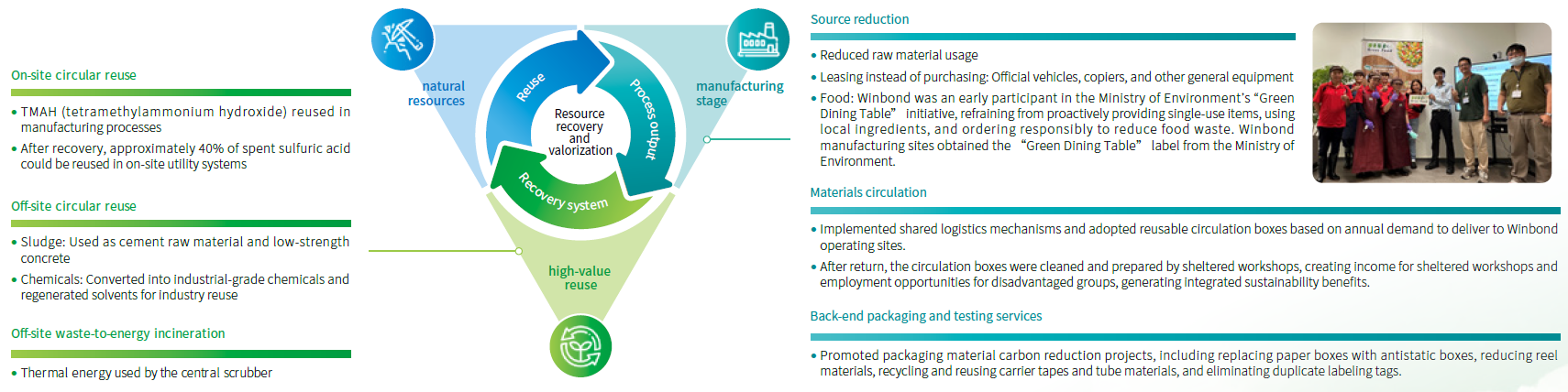
Sustainable resource management actions
At Winbond, the majority of manufacturing waste is effectively recovered through recycling, reuse, or waste-to-energy incineration, with only a small portion requiring final disposal. Guided by resource circulation principles, Winbond continued to
identify new reuse pathways and advanced sustainable resource management. Winbond engaged vendors and supply chain partners through an environmental forum, plastic reduction actions, shared reusable circulation boxes, and packaging reduction. UL2799 Zero Waste to Landfill principles were promoted across the supply chain to support source reduction and resource reuse.