
Our Focuses|Green Product|Research, Development, and Innovation
Green Product
Winbond has integrated our core innovative technology competencies with sustainable energy conservation and carbon reduction goals. Through green product design, digitalizing information systems, and improving production efficiency, Winbond can develop and optimize our products in various different areas, strictly controlling each step of our product process. Winbond promises to deliver the highest quality products to customers, minimizing the carbon emissions required to deliver our products into the hands of customers and consumers. While benefiting from the convenience brought about by technology, Winbond is lowing the impact to environment and helping the overall value chain effectively reducing carbon emissions.


2nd-Gen 1.2V NOR Flash further improving energy efficiency beyond the 50% power savings achieved over 1.8V products
40
%
Enhanced the energy efficiency of CUBE memory solutions
1
pJ/bit
Shipments of Renewable Energy parts
9
%

Research, Development, and Innovation
Innovation in Technology and Services
Winbond provides global customers with comprehensive specialty Memory solutions. Core products include Code Storage Flash Memory, TrustME® Secure Flash Memory, Specialty DRAM, and Mobile DRAM, making Winbond the only Taiwanese manufacturer with proprietary technologies in both Flash and DRAM. Winbond leverages the synergies generated by its product portfolio and adopts a green product design philosophy to meet diverse customer needs. This enables customers to combine their expertise with Winbond's innovative green products for applications in hand-held devices, consumer electronics, computer peripherals, artificial intelligence, automotive, and industrial electronics markets. To achieve environmental friendliness and sustainable growth while providing customers with high-quality and innovative products and services, Winbond continuously invests in research and development, technology, and talent. Winbond is committed to developing innovative products and technologies and remains focused on the following issues:
- Advance green product development across Flash memory, secure Flash memory, specialty memory,and mobile memory
- Strengthen green product development and manufacturing processes, including carbon reduction and energy-saving outcomes
- Develop key technologies for high performance, small form factor, low power consumption, high quality, and security
- Enhance design capabilities, advance process miniaturization innovation, and strengthen intellectual property management
| Key technology | Highlight products | Applications |
|---|---|---|
| Low-power NOR Flash |
|
|
| High-performance NAND Flash |
|
|
| Secure Flash |
|
|
| Dynamic Random Access Memory (DRAM) |
|
|
| High-bandwidth memory |
|
|
Semiconductor Industrial Chain
Winbond possesses an advanced and complete semiconductor industrial chain and professional specialization. This includes IP (Intellectual Property Rights) design and IC (Integrated Circuit) design, wafer fabrication, chip probing, and backend packaging and testing. Additionally, Winbond has been deeply involved in the KGD (Known Good Die) field for many years, working together with chip factories to provide SiP (System in Package) multichip packaging solutions and creating more value in collaboration with the semiconductor industrial chain.
 2026.png)
Code Storage Flash Memory
Winbond positioned“ green semiconductors” as a core development direction and embedded energy saving, high efficiency, and low carbon as key design values. In response to rising demand for low-power memory in mobile devices, wearables, and IoT markets, Winbond launched the world’s first 64 Mb QSPI NOR Flash supporting a 1.2V operating voltage (W25Q64NE). In 2025, the second-generation 1.2V portfolio from 8 Mb to 256 Mb entered the market and further reduced power consumption by 40% compared with first-generation products, establishing a technology benchmark for low-power NOR Flash.
Delivering performance comparable to 1.8V/3V NOR Flash, W25Q64NE reduced use-phase power consumption by 50%, extending battery life for wearables such as wireless earphones, smartwatches, and other battery-powered devices. Driven by its low power consumption advantages, 1.2V NOR Flash sales volume increased nearly tenfold between 2024 and 2025, reflecting rapid market adoption and recognition of energy-efficient products.
To strengthen green products deployment, Winbond expanded the next-generation 1.2V NOR Flash portfolio in 2025 to cover 8 Mb to 256 Mb. The portfolio adopted an optimized circuit architecture and innovative leakage detection technologies, reducing overall power consumption by an additional 40% compared with the previous generation and improving energy efficiency.These products responded to global customers’ needs for long endurance, high performance, and low-carbon storage components and supported customer decarbonization objectives in end applications.
As a leading Flash memory supplier, Winbond continued to reduce use-phase power consumption while also targeting a lower manufacturing carbon footprint through process evolution. For NAND Flash, die area decreased significantly as the process node advanced from 46 nm to the next-generation 24 nm product. For example, for 2 Gb QSPI NAND, the die area of the 24 nm LV series decreased to 72% of the equivalent-capacity 46 nm product, and the carbon footprint decreased by 5% compared with the 46 nm KV series under the same capacity and package. Based on 2025 sales of the KV series 2 Gb QSPI NAND Flash, adoption of the 24 nm LV series would have saved an estimated 1,752 tCO2e.
By continuing to expand a low-power, low-carbon memory portfolio, Winbond reinforced leadership in global green semiconductor markets and continued to deliver quantifiable decarbonization benefits for customers and the value chain.
1.2 NOR Flash | |
|---|---|
| Total Powe Consumption | 50% less power consumed compared to the 1.8V NOR Flash in mainstream use today
(Based on the data from the Forestry and Nature Conservation Agency of the Ministry of Agriculture and the Department of Land Administration of the Taipei City Government: Daan Forest Park annually absorbs approximately 386 tCO2e). |
| Performance | Maintains similar transition level as 1.8V/3V Flash |
| Application | Wireless headphones, smart watches, smart wristbands, smart glasses, and other wearable devices with high power-saving requirements |
Customized Memory Solution (CMS)
Winbond introduced an 8 Gb DDR4 DRAM based on proprietary 16 nm advanced process technology, delivering higher speed, lower power consumption, and a more cost-effective solution for televisions, servers, networking equipment, and industrial PCs. Compared with the previous-generation technology, the 16 nm node enabled smaller die size, higher wafer output, and improved power efficiency, supporting lower carbon emissions. The product supported an industry-leading 3,600 Mbps data transfer rate, exceeding existing DDR4 standards to meet high-speed computing requirements. Process optimization improved signal integrity and reduced leakage current to ensure stable operation at 3,600 Mbps. Leveraging 16 nm advantages, the smaller die area delivered higher density within the same package, reducing total system costs. This design combined high speed, cost efficiency, and process maturity, making it well suited for long product life-cycle industrial and embedded applications. Based on this process platform, Winbond also developed CUBE, 8 Gb LPDDR4, and higher-density 16 Gb DDR4 products to expand next-generation memory offerings.
CUBE is an innovative and patented high-bandwidth memory solution designed for Edge AI applications. By adopting Through-Silicon Via (TSV) and 3D stacking technologies, CUBE delivers higher bandwidth than conventional memory in a small form factor and with low power consumption, supporting AI model computing requirements across Edge AI, industrial automation, wearables, smart monitoring, and automotive electronics. Key advantages include: (1) ultra-high bandwidth and density, delivering 32 GB/s to 256 GB/s bandwidth beyond traditional DRAM; (2) 3D stacking and compact design that support optimized packaging and integration, reducing SoC chip area and improving cost effectiveness for space-constrained devices; (3) high energy efficiency, with power consumption below 1 pJ/bit under a 20 nm process, supporting power-sensitive applications; and (4) design flexibility to enable customization for tailored customer solutions. TSV integration further improves signal and power integrity and overall system efficiency. In 2025, validation collaborations with multiple customers progressed, with small-volume shipments expected to begin in 2026.

A 16 nm DDR4 DRAM delivered smaller die size, higher wafer output, and improved power efficiency, supporting lower carbon emissions. It supported an industry-leading 3,600 Mbps data transfer rate, exceeded existing DDR4 standards, improved signal integrity, and reduced leakage current. Smaller die area delivered higher density under the same package and reduced total system costs.

An innovative customized high-bandwidth memory solution leveraging TSV and 3D stacking to deliver high bandwidth (32–256 GB/s), low power consumption (<1 pJ/bit), and a small form factor. System performance and energy efficiency improved, and design flexibility enabled customization for tailored customer solutions.
Secure Flash Memory
"Security" is not only a technical issue but also a societal and ethical one. Security has significant impacts on the welfare and rights of society, economy, environment, individuals, and organizations, especially in today's digital transformation era and the economic losses and security threats caused by hackers through security vulnerabilities. Security ensures the confidentiality, integrity, and availability of data, information, and assets, preventing unauthorized access, modification, or destruction. Security also enables trust, privacy, and compliance in various sectors such as finance, healthcare, education, and government. However, security is not a one-time task or a static state. It requires continuous monitoring, updating, and improvement to address evolving challenges and risks. Security involves multiple layers, from hardware to software, from networks to the cloud, from users to devices. Therefore, security requires a comprehensive approach covering all aspects of systems and their environments.
Winbond recognizes the severity of these challenges and has pioneered the development and launch of the TrustME® Secure Flash Memory product line. Secure memory is used to store sensitive data and code such as encryption keys, passwords, certificates, and firmware. Secure memory ensures that data and code are protected from unauthorized access, modification, or leakage both physically and logically. Secure memory also provides functions such as encryption, authentication, tamper detection, and self-destruction to enhance security levels and prevent attacks. These cutting-edge solutions are designed to protect Winbond customers' assets and create secure platforms, thus safeguarding end-users in various fields. Winbond’s secure Flash memory is applied in consumer IoT, industrial IoT, servers, networks, and automotive sectors. Winbond is committed to protecting customers from emerging cybersecurity threats. In anticipation of the upcoming post-quantum computing era, Winbond recently launched secure Flash memory enhanced with post-quantum encryption technology (PQC), ensuring that customers continue to enjoy robust protection in the evolving cybersecurity environment.
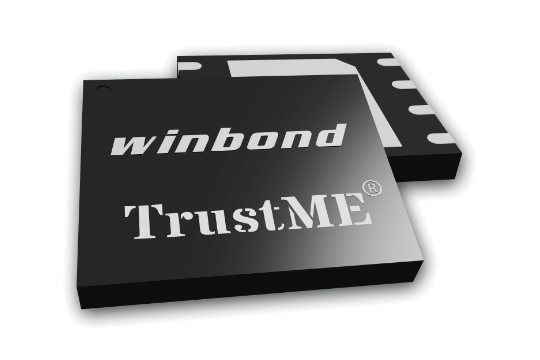
TrustME® Secure Serial Flash Memory | TrustME® Secure Serial Flash Memory |
|---|---|
| The W75F memory series was developed in response to the high security identify verification needs of mobile payment services and other applications, and due to confidential data storage requiring encrypted system hardware modules to possess EAL 5+ security certification. Products in the W75F series are the first secure Flash memory solution in the world to obtain Common Criteria (CC) EAL 5+ certification. They also support secure eXecute-in-Place (XiP), and are able to protect the confidentiality and integrity of codes and data stored in IoT devices. | The W77Q and W77T, compatible with traditional SPI specifications, offer essential security features for IoT endpoints, automotive, networks, and other types of connected devices. These features include hardware root of trust, secure boot, platform resilient, supply chain security confirmation, and robust data protection. Even if the host processor is compromised, the W77Q and W77T facilitate secure over-the-air software updates. |
Green Products
Winbond foresees the market trends of new generation products and continuously invests resources in pursuing green semiconductor design, energy-saving and carbon-reducing production technologies, green energy production, and sustainable innovation of products, aiming to nhance the competitive advantage of green products while providing customers with high-quality products and service support.
Carbon footprint
Winbond advanced product innovation by reducing hazardous substances and carbon emissions in processes, shortening production cycles, and lowering anufacturing costs, while reducing manufacturing-stage emissions. These approaches enabled smaller, more energy-efficient, low-carbon, and environmentally responsible products and reduced materials, electricity consumption, and carbon emissions across end-device manufacturing and use. To precisely quantify carbon emissions during manufacturing, identify process hotspots, and enable data-driven mitigation, Winbond developed an in-house carbon accounting system integrating three modules: (1) GHG inventory, (2) product carbon footprint, and (3) emissions management. The system enabled comprehensive monitoring of production electricity and Scope 1 to Scope 3 GHG emissions. ccurate emissions calculations supported Green Procurement and sustainable supply chain management, enabled reductions in carbon emissions (e.g., at least 60% carbon reduction for products manufactured with renewable electricity), and strengthened compliance to secure low-carbon orders from international customers.
 2026.png)
To demonstrate a long-term commitment to low carbon manufacturing and to enhance transparency in product carbon footprint disclosure, Winbond launched the Carbon Footprint webpage on its official website in April 2025. Customers were able to access product-level carbon footprint information on demand to support product selection and decarbonization planning. Winbond continued to align with international GHG inventory and product carbon footprint standards to strengthen data completeness, accuracy, and traceability and to collaborate with supply chain partners and customers to advance low-carbon product development as a foundation for long-term net zero objectives.

To further reduce environmental impacts from manufacturing, Winbond introduced manufacturing with renewable electricity in 2024 and expanded coverage to ownstream outsourced assembly and testing (OSAT) partners. Green products manufactured with renewable electricity indicate that electricity used across wafer fabrication at Winbond fabs, packaging and testing at outsourced partners, and other process steps originated from renewable electricity. The 13th character“ G” in the product part number is used as an identifier. To enable effective monitoring and management of emissions activities, an advanced carbon accounting system consolidates Scope 1 direct emissions from Winbond manufacturing processes, Scope 2 indirect emissions from purchased electricity, and Scope 3 other indirect GHG emissions data, and integrates manufacturing-stage and OSAT-related carbon emissions information.
Mass shipments of products manufactured with renewable electricity began in December 2024 to key customers with a strong ESG focus, marking a milestone in responding to ESG market trends and addressing increasing demand for energy-saving green products. Compared with conventional energy sources, these products reduced carbon emissions by at least 60%. By the end of 2025, Winbond shipped 451 million products manufactured with renewable electricity and reduced emissions by approximately 35,044 tCO2e, equivalent to the annual carbon sequestration of 91 Da’an Forest Parks.
 2026.png)
We believe that a sustainable future for our planet goes hand in hand with sustainable business growth. Balancing innovation with environmental responsibility is therefore critical to our success. The launch of products manufactured with renewable energy marks a significant milestone in Winbond’s sustainability journey.
Green Innovation Research and Development
Predicting market trends for the new generation of products, Winbond has continuously invested resources into semiconductor design, manufacturing technologies, and sustainable innovations for products, creating competitive advantages and increasing market share for our green products. At the same time, Winbond has provided high quality products and services for our customers, whose needs Winbond has placed first.
Winbond green product development: Design considerations that take into account the product life cycle and reducing carbon emissions.
 2026.png)
Hazardous Substance Management of Winbond
In response to increasingly stringent global environmental regulations, Winbond strengthened hazardous substance management mechanisms with international standards as the cornerstone. In 2025, compliance continued to be maintained against major requirements including QC080000, Restriction of Hazardous Substances (RoHS) Directive, Registration, Evaluation, Authorization and Restriction of Chemicals (REACH), TSCA, and California Proposition 65. Changes to chemical control lists and restriction requirements across jurisdictions were tracked in a timely manner. Regulatory reviews and gap analyses were conducted to ensure conformity of products and processes and to reduce regulatory risks to operations. (Nuvoton hazardous substance management: please refer to the Nuvoton 2025 ESG Report.)
Hazardous Substance-Free (HSF) policy
Winbond’s Hazardous Substance-Free (HSF) policy committed to designing, procuring, manufacturing, and selling products free of hazardous substances to comply with international regulations, meet customer requirements, protect the environment, and fulfill corporate citizenship responsibilities
Hazardous Substance Process Management (HSPM) system
Winbond established a Hazardous Substance Process Management (HSPM) system and issued internal procedures for hazardous substance management. The management representative convened management reviews annually to comprehensively assess policy and targets, external regulations and customer requirements, audit results, and management performance, driving continuous improvement.
Internal controls were coordinated by a cross-functional hazardous substance management team, extending management requirements across the full product life cycle including product design, material introduction, manufacturing, testing, packaging, and shipment. Winbond incorporates end-of-life management considerations into product design and material selection. The Company prioritizes materials that reduce environmental impacts at the end of a product's service life, including no hazardous substances and minimizing pollution risks during disposal and treatment processes. For all products, Winbond evaluates the potential impacts of hazardous substances on human health and the environment, and implements appropriate preventive and control measures based on the assessment results. These measures are intended to reduce potential risks associated with product manufacturing, use, and end-of-life management. Through hazardous substance exposure assessment, portfolio risk review, and change management mechanisms, risks were identified and preventive controls were implemented before new product development, material substitutions, or process adjustments. Training, exception reporting, and continuous improvement processes were integrated to ensure effective system operation. Winbond is committed to continuously enhancing its hazardous substance management capabilities and advancing responsible material stewardship to improve resource efficiency. Through robust governance practices, we strive to reduce the potential environmental impacts of our products, respond to stakeholder expectations, and support our long-term sustainability and business objectives.
In supply chain management, hazardous substance requirements were integrated into supplier selection, letters of assurance, and routine management processes. Suppliers and outsourced processing partners were required to periodically disclose material composition information and support document review and audit activities. High-risk materials and critical processes were subject to stricter controls and sampling inspection based on risk levels, ensuring that each supply chain stage aligned with green products and the Hazardous Substance-Free (HSF) policy, jointly advancing environmental protection and product responsibility.
2025 Progress
- No nonconformities were identified in hazardous substance management operations during the year.
- All personnel completed hazardous substance management training, with a 100% completion rate.
- No nonconformities were identified in hazardous substance audits conducted by customers.
Intellectual Property Management
2025 Patent results of Winbond Group
Patent applications
- Cumulative number of worldwide patent applications exceed 15,330.
- Apply 938 patent applications in 2025.
- 2025 rankings for domestic corporate invention patent applications: Winbond ranked 18th; Nuvoton ranked 23th

Patents granted
- Cumulative number of worldwide granted patents exceed 11,200.
- 776 Global Patents granted in 2025.
- 2025 rankings for domestic corporate invention patent grants: Winbond ranked 11th ; Nuvoton ranked 15th

Note: Data sourced from the Ministry of Economic Affairs, Intellectual Property Office
Against a backdrop of intensifying global technology competition and accelerated sustainability transformation, Winbond anticipated market trends for next-generation products and continued to allocate resources to pursue sustainable innovation in semiconductor design, manufacturing technologies, and products. Sustainable solutions with low carbon emissions and low power consumption were developed to strengthen green competitiveness and market share in international markets. ntellectual property was recognized as a strategic asset that drove innovation, supported corporate resilience, and enabled sustainable growth. Governance was strengthened under a“ Sustainability × Digital” dual-axis transformation.
“Sustainability × Digital” dual-axis intellectual property governance
Sustainability perspectives were integrated into the intellectual property governance strategy. Patent targets, incentive mechanisms, and talent development programs were enhanced to encourage employees to propose green patents and register green trade secrets, strengthening innovation capabilities in sustainability technologies.
Simultaneously, Digital transformation relevant to intellectual property governance advanced through a cross-functional knowledge platform, an efficient patent and trademark management system, an efficient cross-functional patent search system, patent landscape analysis tools, and a highly integrated trade secret registration system. This digital governance architecture improved knowledge flow, strengthened data quality, increased patent output efficiency, and reduced intellectual property risks while maintaining information security controls to protect intellectual property assets.
Winbond (Taiwan) and Nuvoton (Taiwan) obtained TIPS A-Level certification
To strengthen corporate governance and regulatory compliance, Winbond adopted the Taiwan Intellectual Property Management System (TIPS) framework in line with the Corporate Governance Best Practice Principles for TWSE/TPEx Listed Companies and established a complete intellectual property management system. An intellectual property policy and targets linked to business strategy and R&D directions were formulated. Through institutionalized processes and continuous training, innovation culture and intellectual property protection awareness were strengthened, supporting the generation of high-quality intellectual property and sustainable competitive advantages. To ensure resilient system operations, resources were continuously allocated to intellectual property training and staffing above minimum requirements, including personnel qualified as TIPS A-Level self-assessors, ensuring operational redundancy and continuity.
Winbond (Taiwan) and Nuvoton (Taiwan) obtained TIPS A-Level certification (valid through December 31, 2026), demonstrating maturity in institutionalized intellectual property governance. Implementation progress and risk responses for the intellectual property management plan were reported to the Board of Directors, strengthening oversight and transparency. Looking ahead, Winbond continued to integrate global operating strategies, technology R&D deployment, and intellectual property information to further enhance governance.
Intellectual Property Management and Implementation
2025 Intellectual Property Management and Implementation
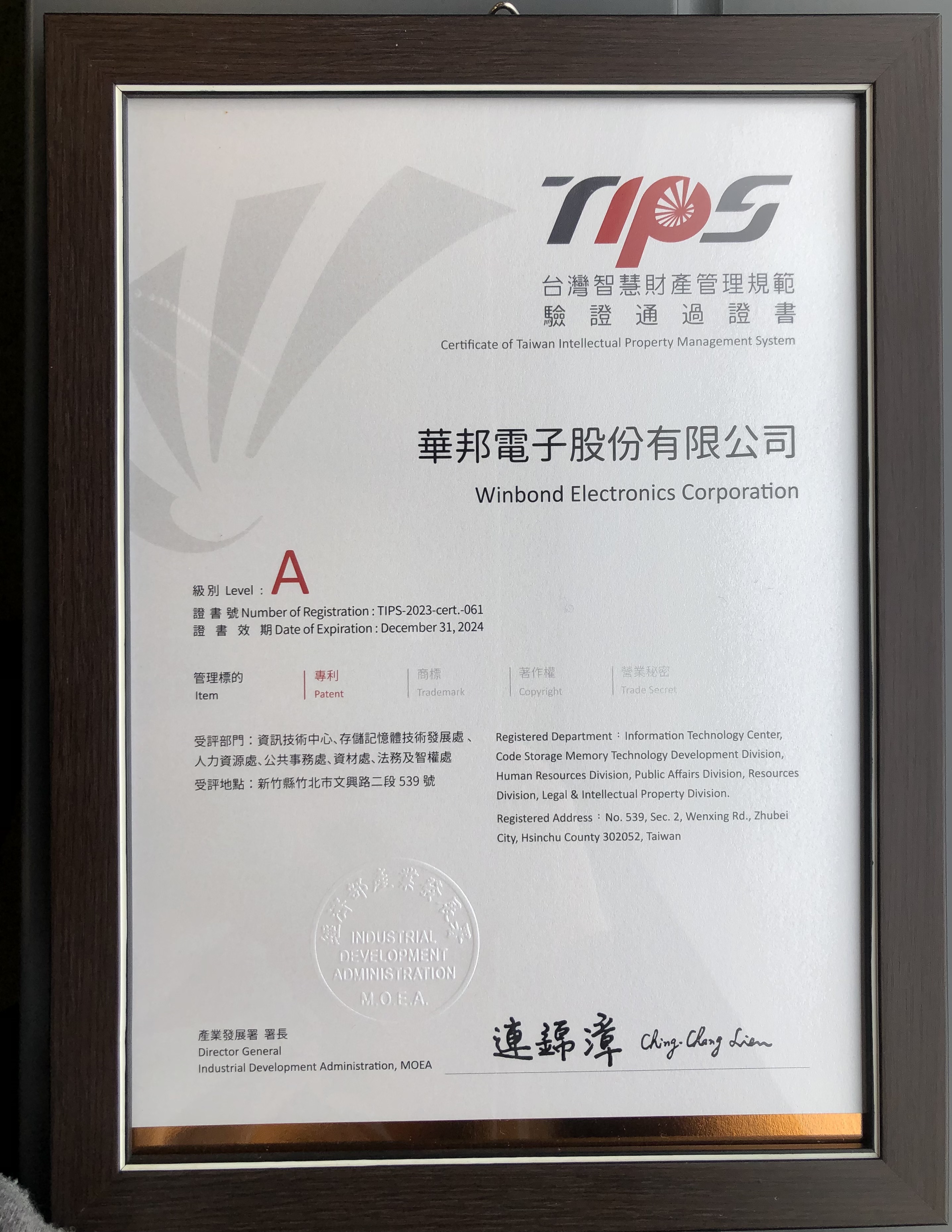
 Winbond obtained re-certification under the Taiwan Intellectual Property Management System (TIPS) on October 15, 2024, with the certificate remaining valid until December 31, 2026.
Trade secret management
Since 2022, Winbond integrated trade secrets into intellectual property strategy and initiated strategic planning for a trade secret registration system. A High-Quality Trade Secret Award encouraged employees to register innovative R&D outcomes, strengthening technology competitiveness. Existing systems were integrated into the trade secret registration system, enabling the platform to serve as a library of technology and innovation knowledge and to preserve critical trade secrets. In 2025, registered cases exceeded 13,000. Customer-related business information, including documents and data exchanged with customers, was protected through internal security systems. Access approvals and permissions followed established procedures and requirements to prevent trade secret or intellectual property theft or leakage. ISO/IEC 27001 Information Security Management System certification was obtained to strengthen information security protection.